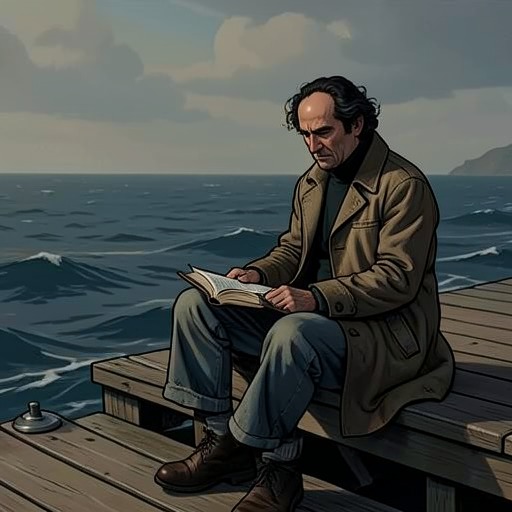
Melville’s first voyage aboard the St Lawrence
The WhaleMelville’s first voyage aboard the St Lawrence was a formative passage from an unsettled life on land into direct experience of the sea. The nineteen-year-old sailed from New York City in June 1839 on a cotton ship bound for Lancashire. The voyage brought hardship and estrangement, but also the first encounters with ocean and whales that would shape his understanding of the maritime world.
Departure After Disappointment
Before going to sea, Melville had already experienced the collapse of the security of his childhood. His father’s bankruptcy forced the family to leave New York City for Albany; two years later, his father died, leaving Melville’s mother with debts and eight children. Melville, then twelve, left school and tried a succession of work: a bank, teaching, and his uncle’s farm. He travelled west hoping to find surveying work on the new canals, reached St Louis, and returned east. An application to become a lawyer’s clerk failed because his handwriting was poor. After these disappointments on land, he turned to the sea.
On 5 June 1839, the St Lawrence sailed from New York City with a cargo of cotton for Lancashire’s mills. Melville was an outsider among the crew, who mocked his middle-class manners, dandified clothes, and unfamiliarity with shipboard life. His isolation made him feel like Ishmael, without a friend or companion. The ship was not an immediate escape from hardship; it was a new setting in which his lack of experience marked him out.
The Sea as Encounter
The ocean nevertheless offered a powerful contrast to the rejection he had experienced ashore. It seemed to swell with a mind of its own, and during a fog off Newfoundland Melville heard sounds that drew him to the ship’s side. There he saw several long, dark shapes barely above the water. They were unlike the monstrous whales in the engravings he had known, yet the sight made him wonder whether the story of Jonah might be true. The encounter did not give him certainty about what lay beneath the surface; it made the sea’s hidden life newly imaginable.
That experience belongs to the book’s larger vision of the ocean as a wilderness that civilization has never truly mastered. Henry David Thoreau describes the sea as remaining wild and unfathomable while cities and civilizations rise and fall. Melville’s voyage gives this idea a personal beginning: the ocean is not simply a route between ports, but an immense presence that unsettles the traveller’s inherited knowledge. The shapes in the fog stand at the threshold between what he had read or pictured and what he could actually perceive.
Liverpool: Maritime Life and Urban Poverty
The St Lawrence called at Liverpool of Melville's First Voyage, the second city of the British Empire. There Melville encountered a converted sloop-of-war serving as a floating chapel, its steeple and pulpit balcony transforming a vessel into a place of worship. William Scoresby, formerly one of England’s leading whalers and then a clergyman, preached there. The scene joined the maritime world Melville had entered to a religious life rooted in the port.
The same visit exposed him to severe urban poverty. He saw a young man displaying a placard about a worker caught in factory machinery, and a destitute mother with children in a cellar. These encounters widened the voyage beyond the ship and the sea: Liverpool presented the wealth and power of an imperial port alongside the human costs of industrial life. The accounts of the chapel and the poor form a sharp contrast, but both belong to the world encountered by a young sailor whose own passage depended on carrying cotton to Lancashire’s mills.
Return and Consequence
On 30 September, Melville returned to New York City aboard the St Lawrence. The voyage had brought him no money, and little had changed in his family’s circumstances. He went back to teaching to help support his widowed mother and four sisters. The return therefore closed the passage without resolving the pressures that had driven him to sea.
What had changed was Melville’s experience. He had lived aboard a ship, faced the estrangement of an unfamiliar crew, seen the ocean’s obscured life, and encountered Liverpool’s religious and industrial worlds. Within a year he left on a more ambitious whaling voyage. The St Lawrence passage was not itself a whaling expedition, but it prepared the ground for that next departure: it made the sea a lived reality before he entered the whaling world that would become central to his writing.